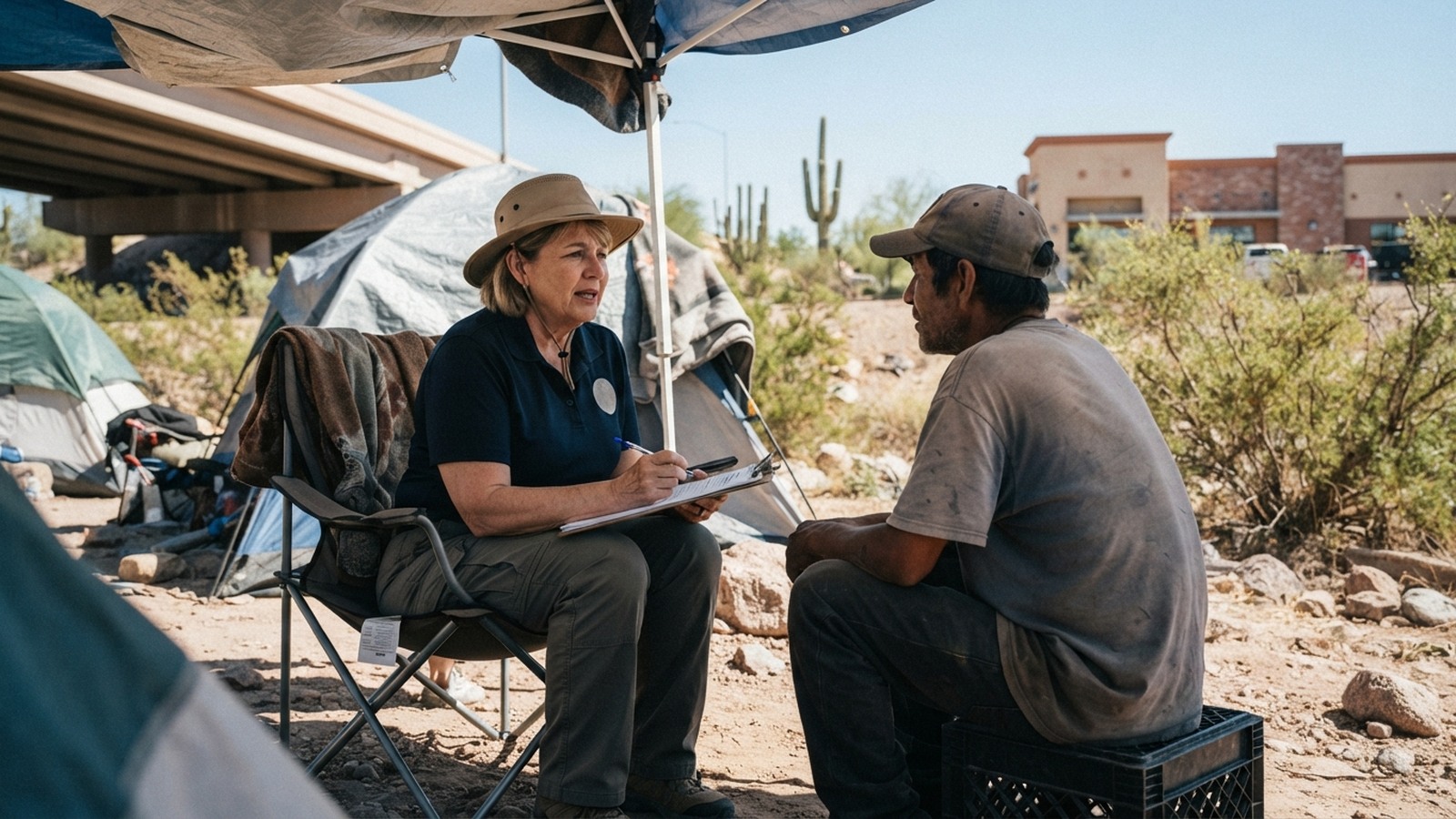
The city’s coordinated entry system now uses a locally developed tool to rank who gets scarce housing resources, aiming to reduce deaths among people living outside.
Tucson’s homeless outreach workers spent a decade using a national questionnaire to decide who gets access to housing resources. This summer, they’re using a locally developed one that centers on a new question: who is most likely to die while living outside?
The change—identifying people at the highest risk of dying on the streets and prioritizing them for scarce housing—is the latest example of how local providers are adapting services to address extreme heat risks.
“One of the main problems we saw in the community was that people were literally dying on the streets while experiencing homelessness, and that was something we really wanted to address,” Zach Simmons, a resource navigator at the University of Arizona’s Southwest Institute for Research on Women, told Arizona Luminaria in 2025.
The survey was created by the Tucson Pima Collaboration to End Homelessness, with local nonprofits like Primavera. It launched in mid-summer last year, so this is the first full hot season it’s been used.
Replacing a flawed national tool
The new survey replaces the VI-SPDAT, a widely used instrument developed over a decade ago. In recent years, it has faced criticism that some questions exacerbate racial inequalities in housing access.
“It’s very difficult, when a person is going through a crisis and trying to figure out their next step, to ask them questions like those in the VI-SPDAT, which are deeply personal,” said Mary Frances Kenion, equity director at the National Alliance to End Homelessness.
For example, the VI-SPDAT asked: “Have you ever done things that might be considered risky, like exchanging sex for money, carrying drugs for someone, having unprotected sex with someone you don’t know, sharing needles, or something similar?”
Tucson’s new survey also asks about exchanging resources for sex, but with less emphasis on risky choices and more on coercion: “While homeless, has anyone harassed you, cyberstalked you, threatened violence against you or another household member, or pressured you to exchange sexual acts for money, drugs, food, a place to stay, clothing, or protection?”
Still, Kenion notes, because people are falling into homelessness so quickly, there aren’t enough resources for permanent housing for everyone, so some prioritization tool is necessary.
“We know that, on average, 17,500 people per week across the U.S. become homeless for the first time,” Kenion said. “Our systems, or our resources, were never designed to respond to that level of demand.”
Heat and homelessness: a deadly combination
In Tucson, extreme heat and homelessness combine to create a deadly situation. In 2024, Tucson saw 112 days at 100°F or above, the most on record. In 2025, it hit 100°F on April 11, breaking a record set in 1895. That record fell again in 2026, when Tucson saw its first 100°F day in March.
Of deaths investigated by the Pima County Medical Examiner’s Office in 2024, 195—or 10%—were people experiencing homelessness. The rate was similar in 2025: 201 of 2,103 deaths, also 10%.
Data from the Medical Examiner was key to developing the new survey, Simmons said. “We were able to determine the leading causes of death.”
Living unsheltered exposes a person to a 200 to 300 times greater risk of dying from heat-related causes, according to a University of Arizona study on rising heat deaths in Pima and Maricopa counties. For people with pre-existing conditions like methamphetamine use or heart disease, exposure to rising urban temperatures, plus living unsheltered, are key factors increasing death risk.
Getting to a cooler place can be life-saving, said Slade Smith, a researcher on the project and now a private attorney. “There just have to be places where people who are now outside can be under a roof and in air conditioning.” That becomes harder when someone faces severe addiction or mental illness.
How the new survey works
To test the survey, community assessors consulted the lived experience council of the Tucson Pima Collaboration to End Homelessness. They ran a pilot with 10 assessors who interviewed over 270 people between November 2023 and May 2024. Compared to the VI-SPDAT, the results better prioritized those they considered at highest risk of dying outside.
The survey includes a small set of tie-breaker criteria that can make someone eligible for housing sooner, such as likelihood of domestic violence and other historical factors shown to increase vulnerability.
“The wonderful thing about having an internally developed survey is that if it doesn’t work as intended, we can modify it. We know how each mechanism works. We know what’s working and what isn’t in our community,” Simmons said.
Tucson still must use federal definitions in the new survey, since a significant part of the city’s response to homelessness has been federally funded—though some of that funding is now at risk. The Trump administration has moved to cut homeless housing programs and divert funds from permanent housing, a move Tucson is challenging in court.
The survey feeds into a “By Name List,” a database that stores responses. People on the list are then prioritized for housing based on vulnerability. But the new survey, like the old one, operates with very limited housing resources.
“Changing the coordinated entry assessment tool isn’t going to suddenly create more housing or more availability,” Simmons said. “It’s like a zero-sum game.”
If a person reaches a priority position for housing, they can lose it if an outreach worker fails to contact or find them three times using three different methods when a spot opens. That spot then goes to the next person on the list, and the person who lost the chance must redo the survey for future vacancies.
Simmons acknowledges the system is imperfect but hopes the new list will keep more people alive while they move through the housing access system.
“The main goal in developing it was to try to prevent and reduce mortality while people are experiencing homelessness.”