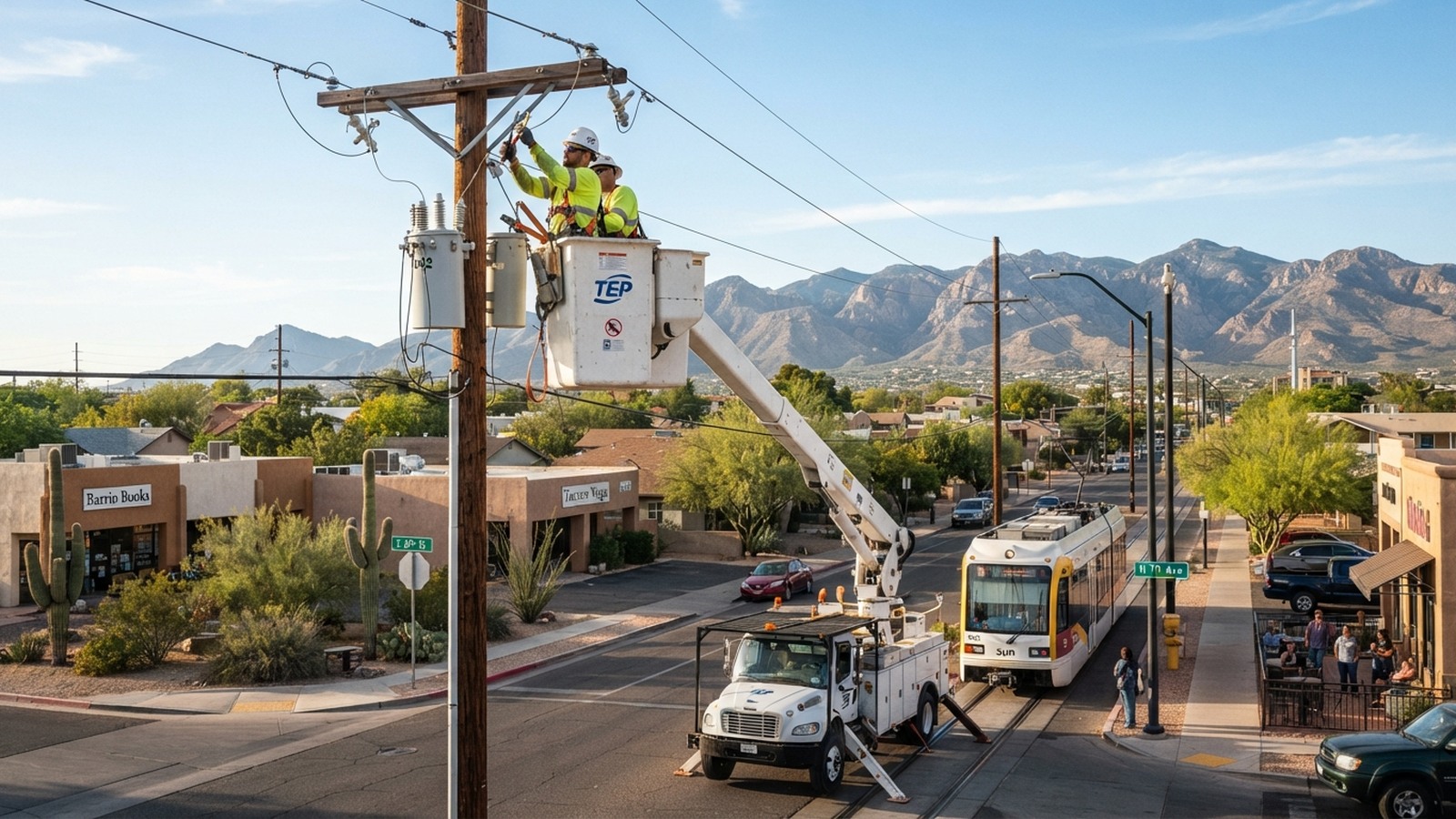
Tucson Electric Power explains the real-time balancing act that keeps the lights on, from 60-hertz frequency to digital substations.
Tucson Electric Power (TEP) keeps the lights on for hundreds of thousands of customers in the Tucson area, but most of us never think about the complex system behind the switch. In a recent explainer, TEP highlighted five behind-the-scenes facts about how the grid operates—a reminder that reliable power is a constant, precision choreography.
The grid’s heartbeat: 60 hertz
North America’s alternating current (AC) power cycles between positive and negative polarities 60 times per second. That 60-hertz frequency is the grid’s heartbeat, and TEP’s system operators monitor it like a doctor with a stethoscope. If frequency sags below 60, it signals that demand is stretching supply thin. A sudden change—like a transmission line failure or a surge in demand—could force power plants offline, triggering outages to restore balance.
Electricity is the ultimate on-demand service
Unlike most products, electricity can’t be stored on a shelf. It must be produced at the exact moment it’s used. Every second, the grid matches supply to demand, from morning routines to business operations to temperature swings. If demand rises, supply must follow immediately; if demand drops, generation eases back just as fast. There’s no pause button—just a nonstop, system-wide conversation in real time.
Substations: unsung heroes of reliability
Substations don’t get much attention, but they do critical work. Electricity travels on transmission lines at extra high voltages—often hundreds of thousands of volts—to move long distances with less energy loss. That voltage would be catastrophic inside a home, instantly destroying appliances and endangering occupants. Substations step down voltage to safe levels, route power along different paths, isolate problems, and provide real-time data operators rely on.
Protection systems make split-second decisions
When something goes wrong—a lightning strike, a fallen branch, equipment failure—protective equipment responds in fractions of a second. Relays, breakers, and automated devices sense abnormalities and act instantly to isolate problems and protect equipment. Often, they restore service so fast customers never notice. These systems work independently and together to prevent small problems from becoming big ones.
Digital substations: the future is fiber
Inside many modern substations, traditional copper wiring is being replaced with fiber-based digital systems. Where dozens or even hundreds of physical connections once existed, a handful of fiber lines can carry the same information faster and more reliably. Digital substations reduce complexity, improve diagnostics, and enable real-time monitoring. TEP says it’s exploring them to build a more precise, smarter grid for the future.
For TEP, the best compliment is when customers don’t think about the grid at all. But behind that simplicity is a system demanding precision, coordination, and constant attention—so that flipping a switch feels effortless.